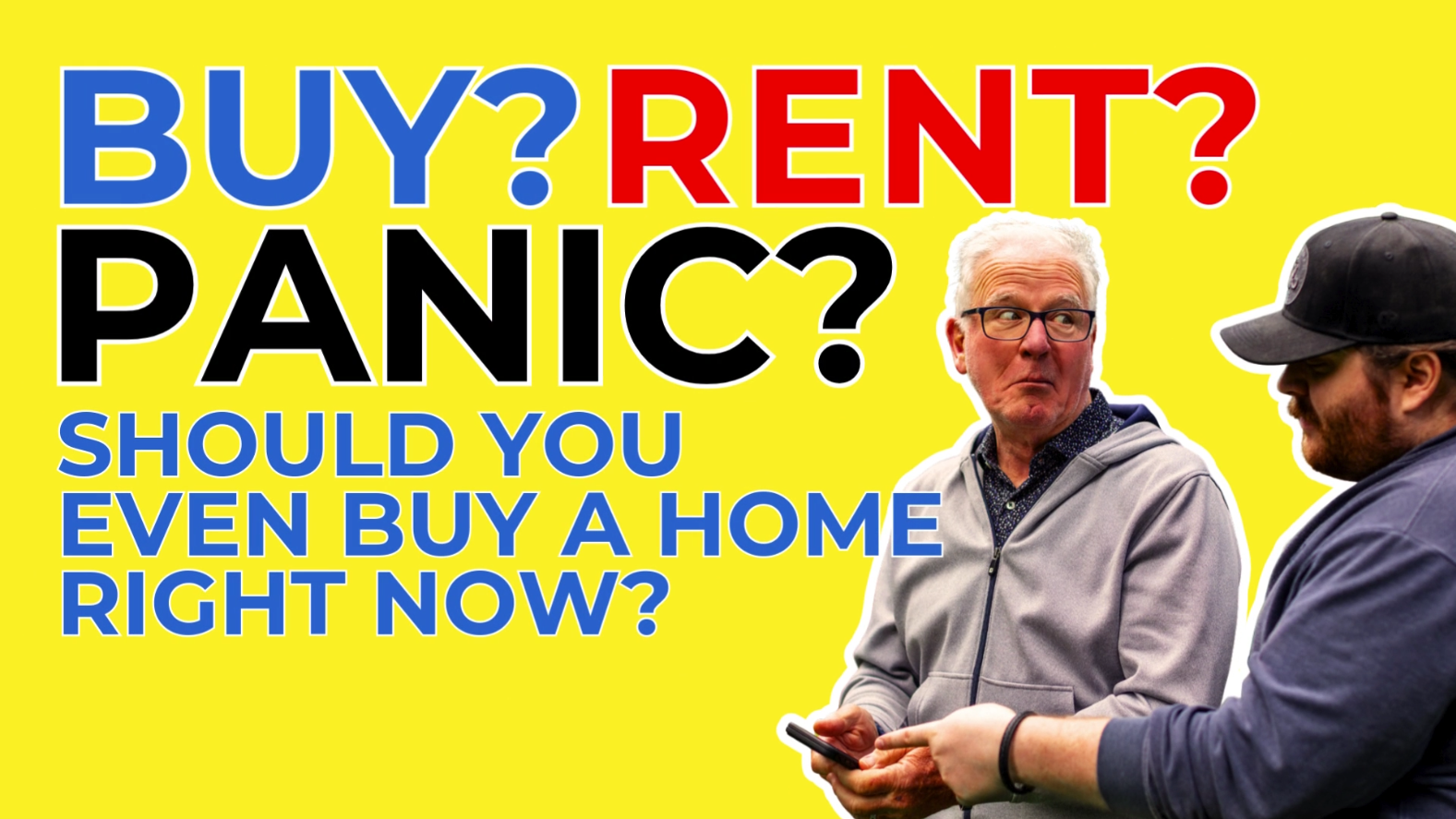
In this video we break down the real numbers behind renting vs. homeownership in Barrie and across Ontario, and what first-time buyers can realistically do to get into the market. If you're struggling with affordability, down payments, or rising rent, this will give you clarity and real options.
Buying a home is still possible, but only if you understand the strategies that actually work in today's market.
Should You Rent or Buy in 2025-2026?
This is the question everyone's asking as we head into 2026. Is it time to rent? Is it time to buy? The answer isn't simple, but here's our take.
We're always going to be of the opinion that you should buy if you can afford it. Paying down your own mortgage is certainly better than paying down someone else's mortgage. Yes, home prices are high, but the amount of money you would save by not buying now and renting instead? You're just better off buying.
The Real Cost of Renting in Barrie
Right now, rent for a two-bedroom in Barrie is somewhere around $2,300 to $2,600 a month. That means you're paying $25,000 to $30,000 a year for somebody else's mortgage. You're buying it down for them, building their equity, not yours.
The biggest challenge is: how do you get to a position where you can afford it? Where do you get your down payment from? What are some realistic options?
The Income vs. Home Price Problem
Here's the brutal reality: the average salary in Barrie is like $60,000 to $70,000. On a quick search, that only gets you like $150,000 for a mortgage, assuming you don't have any outside debt.
When the average sale price in Barrie for a detached home is $770,000, what are you even supposed to do?
This is where people get discouraged and think homeownership is impossible. But there are strategies that actually work.
How to Actually Afford a Home: Real Strategies That Work
Strategy 1: Get a Co-Signer
Honestly, the biggest "cheat" for getting into a mortgage is a co-signer. It's kind of the only real way for many first-time buyers. The banks have a reason for doing what they're doing, and having a parent or family member co-sign changes everything.
For instance, one of us was only able to apply for a couple hundred thousand dollars for a mortgage, but the house was $650,000. Just the fact that mum's name was also on title suddenly made it okay. She's making the payments herself, her mum's doing nothing, just her name is on there, and the banks are suddenly like, "Okay, this is fine now."
It's called security. The bank sees the co-signer as backup, which dramatically increases what you can borrow.
Strategy 2: Joint Ownership (Combining Incomes)
This is pretty simple and self-explanatory. Instead of going in alone at your $60,000 or $70,000 a year income with only a $150,000 mortgage approval, you get another person with that same amount, maybe even a third person. All of a sudden, you're at $450,000, which gets you into a townhouse or something comparable.
Having more people on title will inadvertently get you a higher mortgage essentially because you're collectively putting your income together.
Important: The biggest thing to make sure is that you have a proper contract and that the ownership is all equal and shared across. Everyone needs to be protected legally.
Strategy 3: Know Your Numbers (And Don't Mess Them Up)
Part of the big thing is knowing your numbers. Know your income, what your debt is, and understand what you can actually afford.
One of the biggest mistakes people make when they go to buy a house is they'll put an offer in on a property and then show up for one of the inspections prior to closing with a brand new car. They just went out and financed a new vehicle, and suddenly their mortgage approval falls apart.
Critical rules when buying a home:
- Don't incur any new debt
- Don't buy anything unless you're paying cash for it
- Even paying cash can be a problem if you show that part of your down payment (say $60,000 to $70,000) and you suddenly take $25,000 of that and put it into a new vehicle
If you're buying a house, make sure everything else stays status quo. Don't change anything anywhere. If anything, pay down outstanding debt to get your numbers in a better situation.
Don't Give Up Before Exploring Every Option
The attitude online is very defeatist, and probably rightfully so when it comes to homeownership. But there are ways around the challenges.
Before you get into a defeatist attitude, just please make sure that you've taken a look at all possible avenues. You've looked at your situation, you've figured out whether you're actually able to afford a home.
At the end of the day, some people just aren't going to be able to afford a home right now. That's reality. But many more people could afford one than actually think they can.
First-Time Home Buyer Programs
There are programs out there. First-time home buyer programs, land transfer tax rebates, down payment assistance, all sorts of things. Check into all of those before you assume it's impossible.
Renting vs. Buying: The Real Trade-Offs
Advantages of Buying
- Fixed payments: You've got a fixed 5-year mortgage, and you know what that payment is going to be for the next 5 years, as opposed to your rent increasing 2% to 3% every year
- Building equity: You're paying down your own mortgage, building wealth
- No rent increases: Your mortgage should stay roughly the same
- It's yours: The freedom of ownership
Disadvantages of Buying
- Repairs and maintenance: When you're buying a home, it's obviously yours, which is great. But one of the cons is also it's yours. If something breaks down, you have to fix it.
- Unexpected costs: A gas valve in a furnace going out? That's $1,000 out of pocket, just like that. If you're a tenant, you wouldn't have to worry about it.
- Less flexibility: As a tenant, you can pretty much move out after your first year lease anytime you want. With homeownership, to unload your house within a year is not the smartest financial move.
Advantages of Renting
- Flexibility: You can move relatively easily
- No repair costs: Landlord handles everything
- Lower upfront costs: No down payment needed
Disadvantages of Renting
- No equity: You have no equity building whatsoever
- Rent increases: Your rent will likely go up every year
- No control: You're building someone else's wealth, not yours
How Long Are You Planning to Stay?
If you're buying a house, you need to ask yourself: how long are you going to stay where you're going to stay?
If you're going to stay in Barrie, that's great. You can buy a house anywhere. But what happens if you've got a job transfer coming up that's going to take you to Toronto or to Ottawa?
If it's not a 5-year plan or at least a 3-year plan, then renting is probably a better situation for you. You don't want to get stuck into a property where you suddenly have to sell it. Even if you do make money, by the time you pay lawyer fees and real estate fees, you still may not be in a good position or could end up losing money.
Can You Realistically Save Enough?
Here's an exercise you need to do: if you tighten the screws, really lived that poverty life as much as you possibly can, how much money could you put away in a year?
Do that. Figure out that number and find out if it's actually realistic for you to save for a down payment. Maybe it's a 3-year or a 5-year plan ultimately.
Make sure you get the right information, hunt that information down, and then find out the true facts about whether or not you can afford a house. Not just something that you've seen somewhere online. Go deep, dig into every possible chance or opportunity that you can to see if homeownership is something that you can get into.
When Renting Might Actually Be Better
At the end of the day, there are some people who just don't want to own a home. And that's fine. If owning isn't for you and you're happy renting, by all means, power to you. Who are we to tell you what you can or can't do?
But as someone who got into homeownership three years ago, we personally love it. We love having that it's ours.
We just want to make sure that people online do not just get caught up in the doom and gloom and realise that every single person's situation is almost entirely unique. Go and ask the right people before you lose all hope because you might be surprised.
The Bottom Line
Buying a home in 2025-2026 is challenging, but it's not impossible. The strategies that work:
- Co-signers to boost your buying power
- Joint ownership to combine incomes
- Knowing your numbers and not making mistakes with new debt
- Exploring first-time buyer programs
- Having a realistic 3-5 year plan
Yes, home prices are high. Yes, the average salary doesn't come close to covering the average home price. But with the right strategy, support system, and financial planning, homeownership is still achievable for many people who think it's out of reach.
Don't let the online doom and gloom convince you it's impossible before you've explored every option. Talk to the right people, run the real numbers, and make an informed decision based on your unique situation.